
AMITW Weekly Nesting Numbers 8/15/2025
8/9/2025 – 8/15/2025 Loggerhead Green
Nests this week 2 1 1
False Crawls this week 4 2 2
2025 Total Nests 540 525 15
2025 Total False Crawls 826 796 30
2025 Hatched Nests 256 250 6
2025 Nests Inventoried 234 230 4
2025 Hatchlings Produced 17,825 17,611 214
2025 Adult Disorientations 30 28 2
2025 Hatchling Disorientations 88 87 1
Nests remaining on the beach 293 282 11
Hatches and hatchlings abound this week. We are grateful to all the folks who have called our hotline to alert us to hatchlings found in the road, pools, or otherwise not found on the beach! AMITW’s 24/7 hotline 941-301-8434 allows us to promptly respond to hatchlings and adults that are in trouble. Our team has been trained to assess each situation to determine if hatchlings can be released immediately, need rest, or need to be taken to rehabilitation at Mote Marine Laboratory Hatchling Hospital.
At this time last year, we had Tropical Storm Debby which caused damage to at least 200 nests. We are happy to report that, other than some nests being affected by the heavy rains we got on Sunday night, most nests have remained safe from storm damage. We are right at the halfway point with about half the nests laid still left on the beach, and we’ve already produced nearly 18,000 hatchlings! If the storms hold off, this may be a big year for hatchling production! Let’s all make sure these hatchlings make it to the water by keeping the beach nice and dark so the night sky will lead them to the water:
• No cell phone or flashlights (even red lights) on the beach at night
• Close blinds so interior lights cannot be seen from the beach
• Use turtle-friendly lighting (red or amber LEDs) with shields or turn off lights that can be seen from the beach.
• Report any non-turtle friendly lights that can be seen from the beach to your local code enforcement.
Nest excavations
With so many hatches, you will be seeing us conducting nest excavations nearly every day. Nest excavations are conducted 3 days after a hatch is observed in order for us to count how many eggs were laid and determine the how well the nest hatched. When we are finished counting the nest contents, we will bury everything back in the nest for it to compost and give back nutrients to the sand, which help the dune plants grow. If you see us working at a nest, feel free to come up and watch as there may be some straggler hatchlings found in the nest and you might be able to see them released!
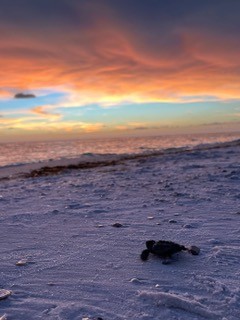
Hatchling Release At Sunset: Disoriented hatchlings and some live hatchlings found during our nest inventories are released at sunset. Credit: Maureen Richmond
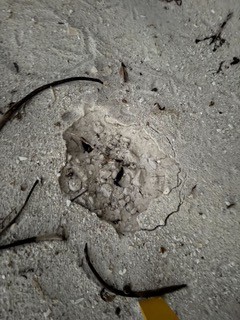
Nest Hatching: Our volunteers were lucky to observe the hatch of a nest in Anna Maria this week. Here’s what it looked like when it first was beginning to hatch. Credit: Mary Anne Muniz
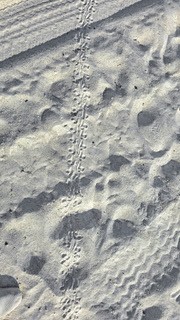
Hatchling Tracks: Every morning we check every marked nest to see if has hatched. Little hatchling tracks like this one tell us that hatchlings have emerged. Credit: Amy Waterbury
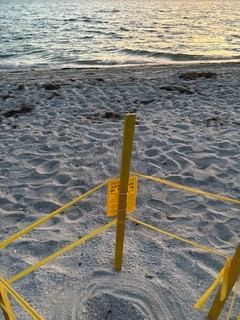
Good Hatch: This is a great example of a nest that has hatched and gone towards the water. The depression indicates that hatchlings emerged and the multiple hatchling tracks in the direction of the water, show us this emergence was successful! Credit: Kristen Mazzarella
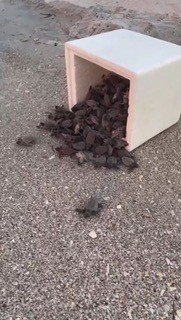
Hatchling Release: 163 loggerhead hatchlings were found overnight on Gulf Drive in Bradenton Beach this week from multiple nests that disoriented. They were released by AMITW. Credit: Linda O’Neal