
AMITW Weekly Nesting Numbers 9/3/2025
| 8/30/2025 – 9/5/2025 | Loggerhead | Green | |
| Nests this week | 0 | 0 | 0 |
| False Crawls this week | 0 | 0 | 0 |
| 2025 Total Nests | 542 | 527 | 15 |
| 2025 Total False Crawls | 828 | 797 | 31 |
| 2025 Hatched Nests | 387 | 379 | 8 |
| 2025 Nests Inventoried | 397 | 388 | 9 |
| 2025 Hatchlings Produced | 27,887 | 27,438 | 449 |
| 2025 Adult Disorientations | 30 | 28 | 2 |
| 2025 Hatchling Disorientations | 140 | 139 | 1 |
| Nests remaining on the beach | 100 | 94 | 6 |
Sea turtles appear to be done nesting for this season and only 100 nests remain on Anna Maria Island beaches. Turtle Patrol continues our daily patrols for new adult crawls and checking on every marked nest. We are finding a few hatches each day and inventorying every nest 3 days after the hatch is documented. We love sharing these experiences with the public, so if you see us doing an nest inventory, please come and check it out – you might even get to see some live hatchlings!
Hatchlings!
We continue to see an excellent emergence success rate (percentage of eggs with hatchlings emerging from the nest) from the nests this year. With an average around 69%, nests are doing really well! It’s reflected in the number of hatchlings that are being produced – nearly 28,000 and counting!
Disorientations
Hatchlings use light as a cue to find the water – they go away from dark shadows and towards the brightest horizon. We have documented 140 nests with hatchling disorientations this year. This is very sad news. This means that a minimum of 3,854 hatchlings from 140 nests traveled the wrong way by following artificial lighting and may or may not have made it to the water. We use the tracks left by hatchlings to determine how many hatchlings disoriented and categorize them into three groups (5-10 hatchlings, 11-50 hatchlings, 50+ hatchlings). We then multiply the number of nests in each category by the minimum number in each category to calculate the minimum number disoriented. The actual number of disoriented hatchlings is likely MUCH higher than the minimum. Also, not all disorientations can be accurately categorized when hatchling tracks are obliterated by rain so some disorientations are categorized in lower categories or not documented at all. Even more sad is the news that we have documented at least 169 dead hatchlings as a result of disorientations. Please spread the word about keeping the beach dark for the remaining hatchlings so we can make sure they make it to the Gulf safely and without using up much of their energy!
| 2025 Disorientations | # of Nests Disoriented | Min # Hatchlings Disoriented |
| 5-10 Hatchlings | 21 | 105 |
| 11-50 Hatchlings | 58 | 638 |
| 50+ Hatchlings | 61 | 3,111 |
| TOTAL | 140 | 3,854 |
Here’s how you can be turtle friendly:
- No cell phone or flashlights (even red lights) on the beach at night
- Close blinds so interior lights cannot be seen from the beach
- Use turtle-friendly lighting (red or amber LEDs) with shields or turn off lights that can be seen from the beach.
- Report any non-turtle friendly lights that can be seen from the beach to your local code enforcement.
If you find a hatchling in danger, in the road, in a pool, or just off the beach, here’s what to do:
- Pick up the hatchling to get it out of danger
- Place it in a bucket/container (you can put a little sand in the bucket but NO WATER!)
- Call AMITW’s Hotline 941-301-8434 for more instructions
- Please do not release hatchlings on your own. If they are sick or injured, they may not be able to swim.
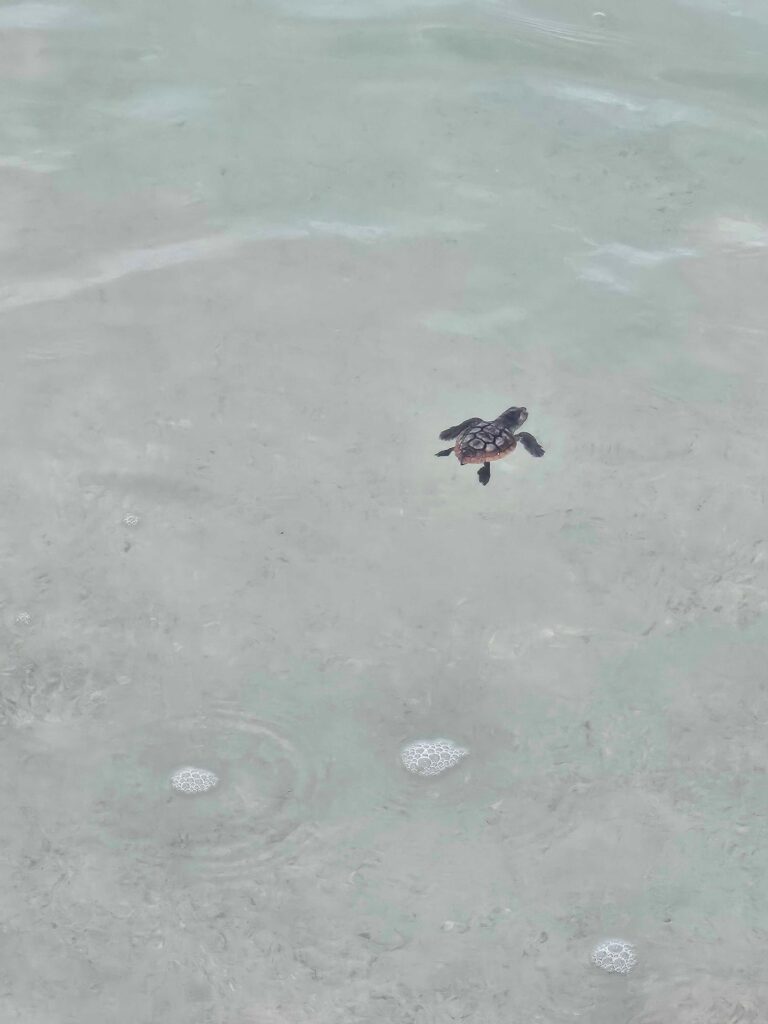
Hatchling Swim – a loggerhead hatchling takes a breath as it begins its swim to find the floating sargassum (seaweed) line far offshore of Anna Maria Island. Hatchlings use the energy they get from absorbing their yolk sac to make their way to the water and swim to the sargassum line where they will find more food and shelter. Credit: Debbie Haynes
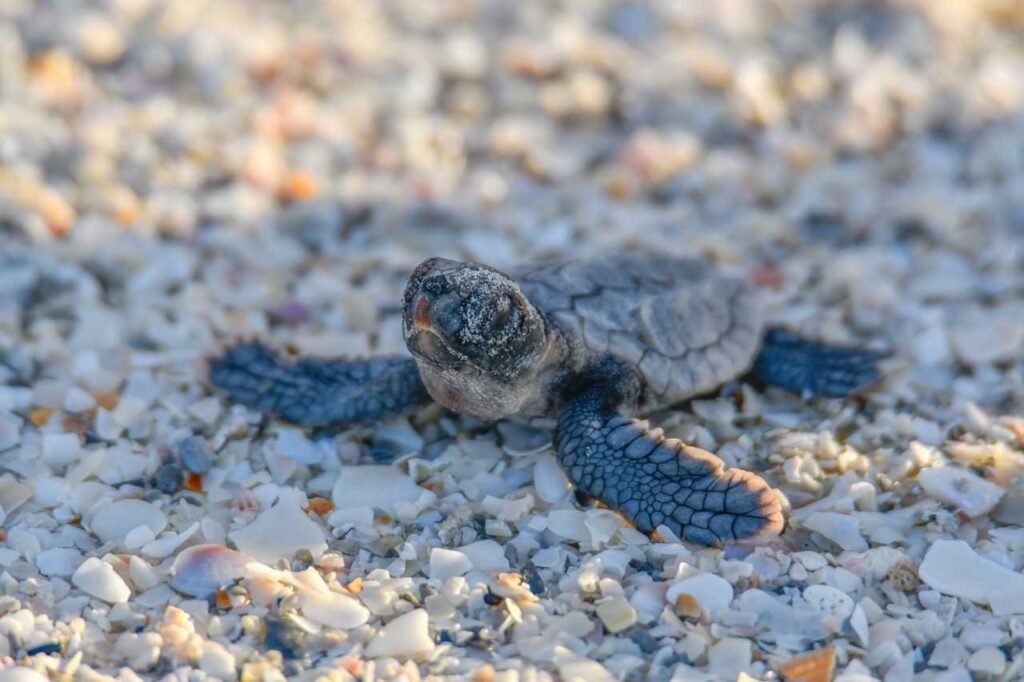
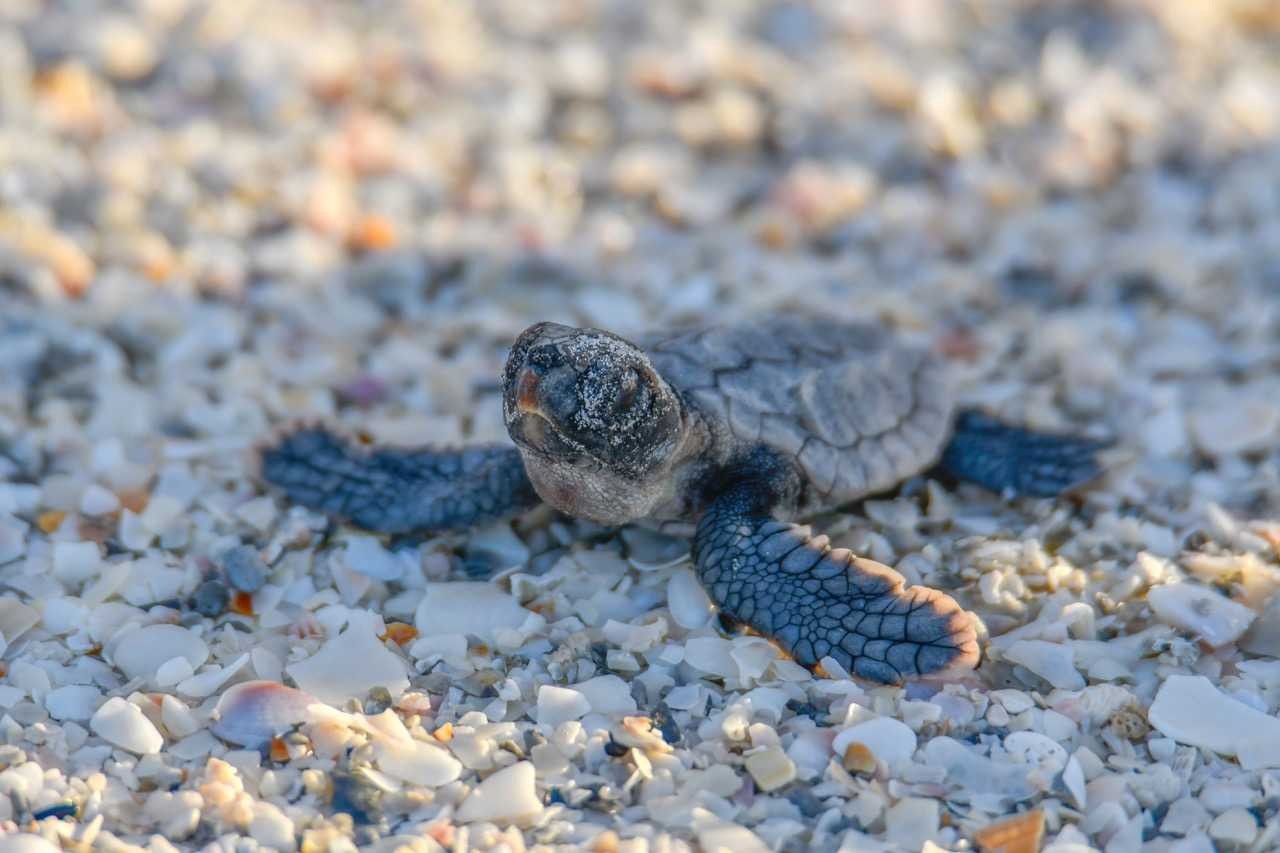
Loggerhead Hatchling – closeup of a loggerhead hatchling making it’s way to the water on Anna Maria Island. Credit: Amy Waterbury
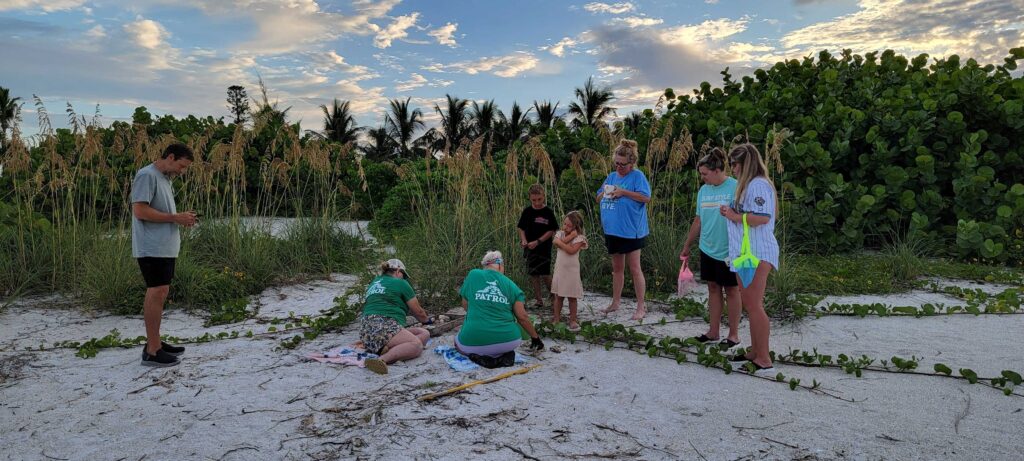
Nest Excavation – AMITW volunteers Carla Boehme and Karen Anderson draw a crowd as they excavate a nest that hatched three days prior. Nest excavations help us determine how well the nest did as we count all the eggs and see how many hatched and how many didn’t hatch. Sometimes we even find a live hatchling or two! Credit: Chuck Anderson
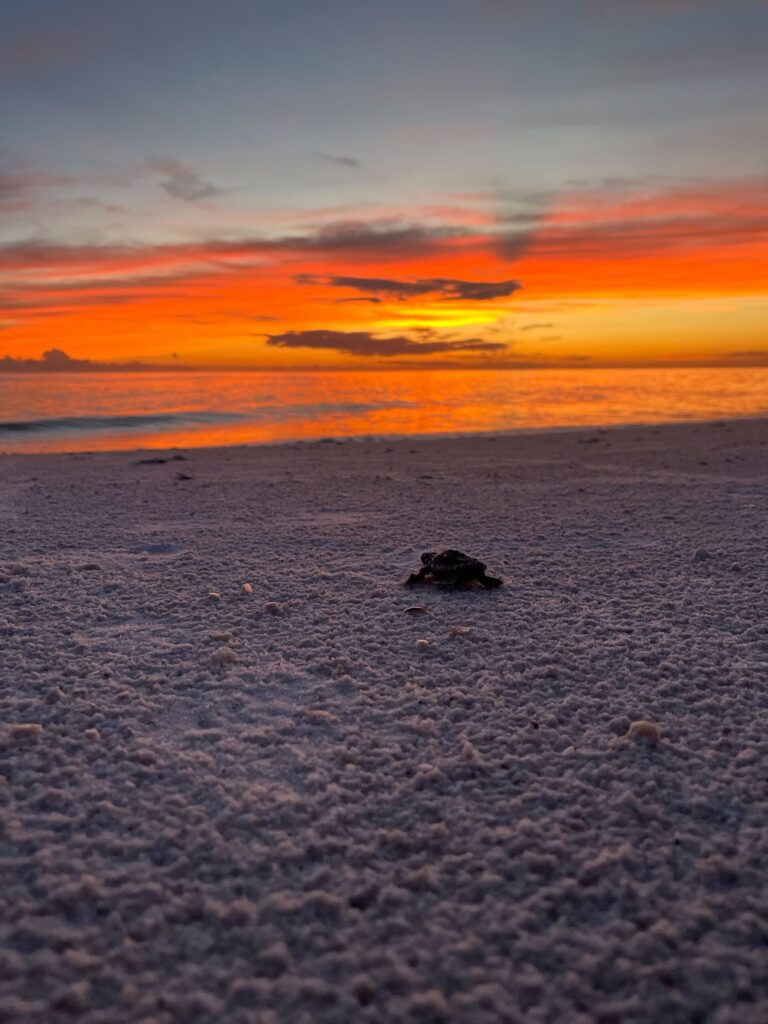
Hatchling Sunset – A hatchling is released by AMITW Turtle Patrol at sunset. We usually release hatchlings immediately whenever possible, but sometimes the hatchling needs to rest for the day before it is ready to make it’s journey. Credit: Andrea Cramer
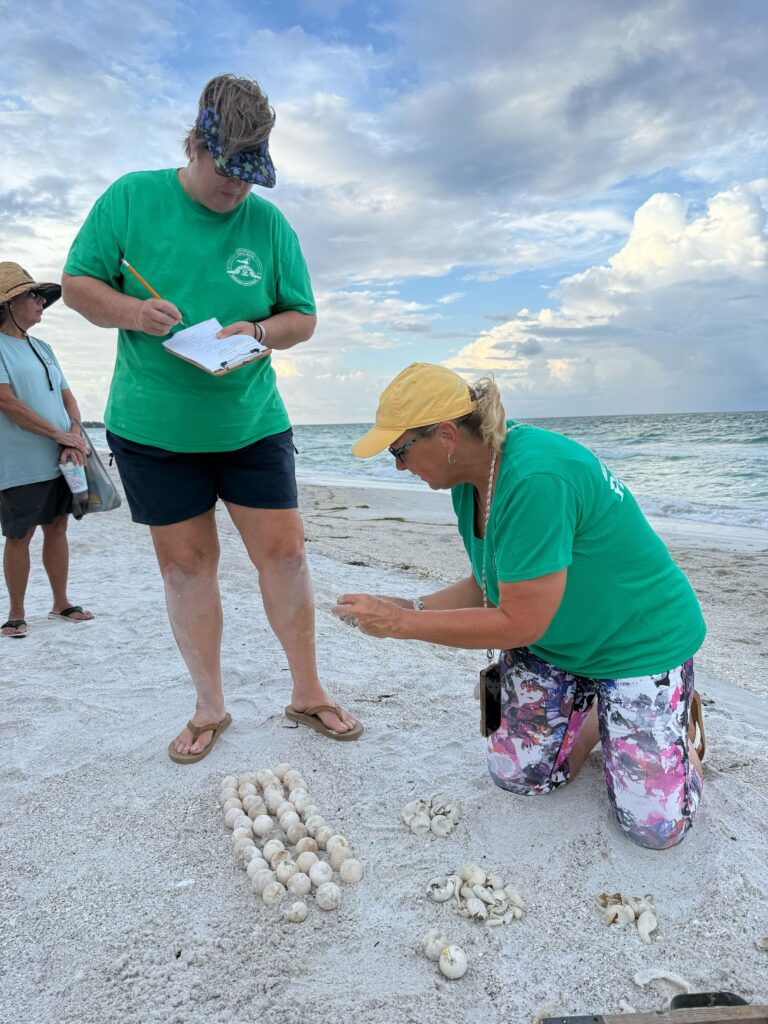
Excavation: AMITW volunteers Danielle Kimberly and Cindy Hodge conduct a nest excavation – counting the hatched eggshells and whole unhatched eggs in the nest to determine the nest’s hatchling emergence success. This year the nests are averaging 69% emergence success which is great news for sea turtles! Credit: Monica Carruth
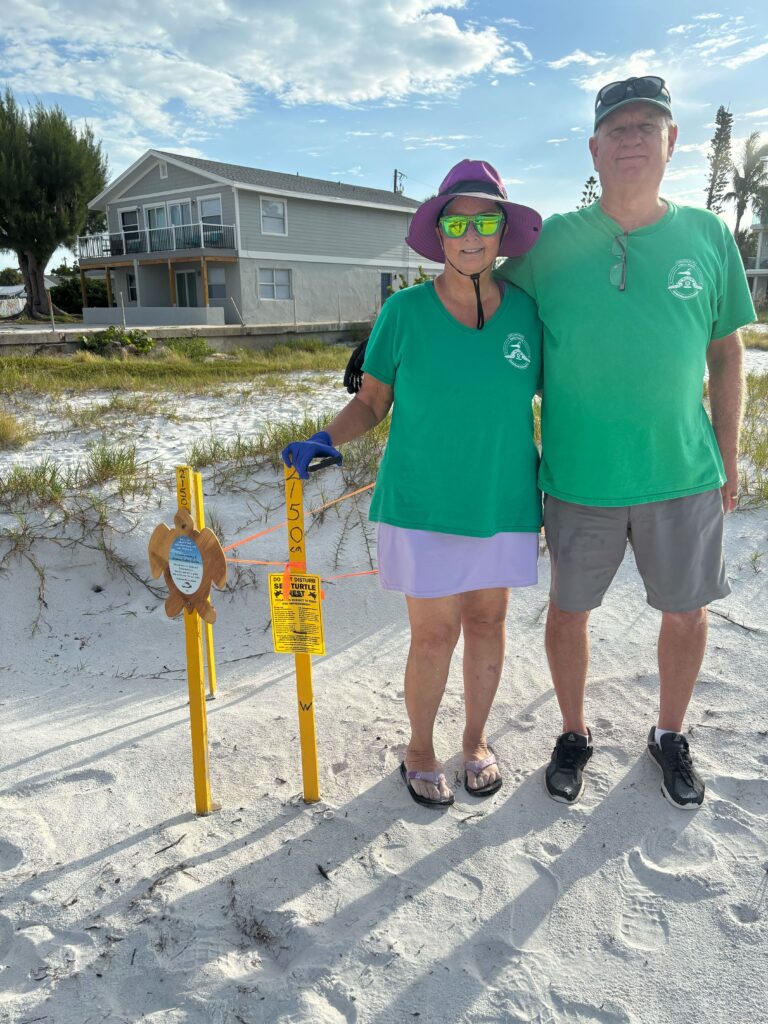
Nest Adoption: AMITW volunteers Karen and Chuck Anderson pose in front of the nest adopted in memory of their niece. Nest adoptions are closed for this year, but will open for 2026 soon! Credit: Carla Boehme