
Reen Troy
Written by Emma Hartman
Reen Troy didn’t grow up in a family of artists, but art found her early. As a young child, she would hunch over a beat-up, hand-me-down coloring book, feverishly filling in the lines with a set of old, broken crayons—an experience she describes as “finding a quiet place in a rather chaotic household.” Recognizing her daughter’s passion, Troy’s mother nurtured it from the beginning.
“I think it was my 6th or 7th birthday. I got a box of 64 crayons—brand-new—and that was like winning the lottery. I was so excited! They were so new, and the sharpener on the back?! And some blank paper. So, that’s what really sort of got me going,” she recalls with delight still ringing in her voice.
As her passion for art grew, Troy found her interest piqued by the Sunday funnies. Drawn to their bold colors and clean outlines, she would cut out scenes from Charles Schulz’s Peanuts and other comic strips, meticulously tracing the characters to hone her craft.
Troy credits both the era and her education for nurturing her creativity. While she laughs that children of the 1970s often had “little parental supervision,” she also remembers a school experience where art was never treated as an afterthought. After satisfying all her high school AP credits, Troy was able to devote two class periods a day to art. It was during those hours that her artistry was given space to expand and mature.
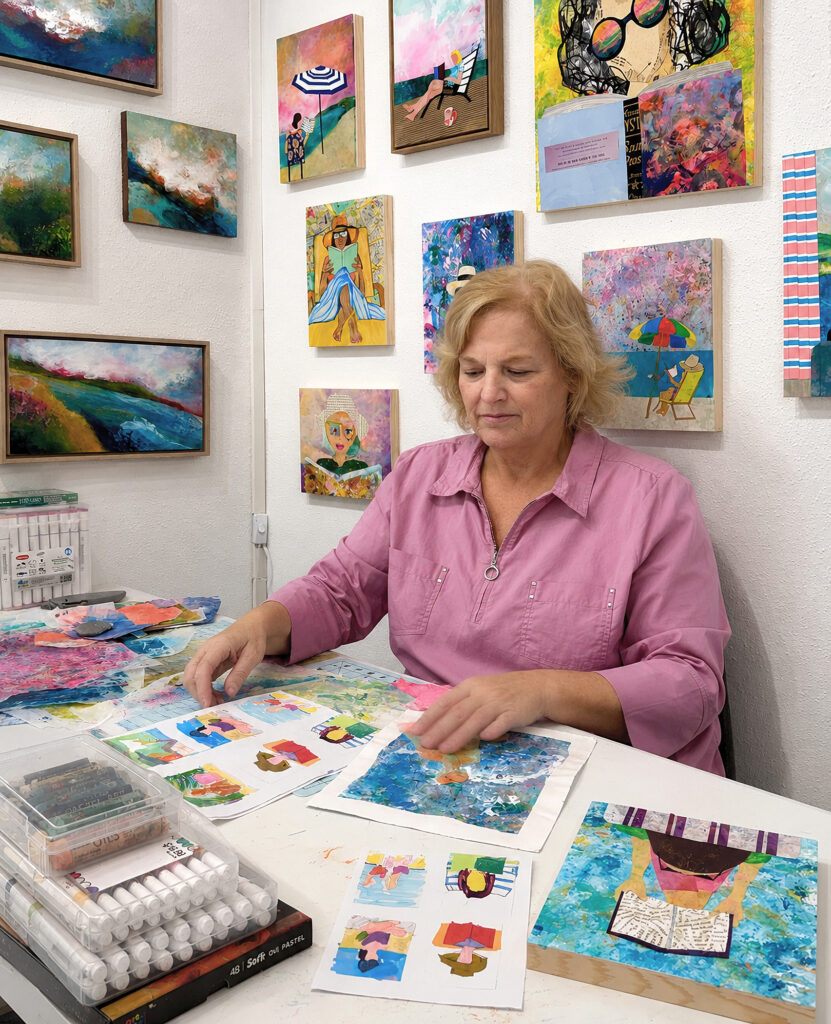
“Another bonus was that they had a budget!” Troy says with unfaded enthusiasm. “I remember walking into my teacher’s storeroom and seeing all these beautiful paints and markers, pencils and watercolors!”
Her teacher-turned-mentor encouraged students to experiment with techniques that would be unusual in most classrooms today. “He’d let us do printmaking and lino cuts with the lino knives—which they would never give to anyone nowadays,” she recalls with a laugh.
But introducing Troy to new techniques wasn’t her mentor’s only unconventional contribution to her artistic development. He also guided her through the difficult process of assembling a portfolio for art school applications. A process that, in those days, required rare equipment and skills like photographing artwork, curating a cohesive body of work, and producing 35mm slides.
The painstaking project of assembling her portfolio paid off. After being accepted to the University of Michigan, Troy earned admission to the university’s art program, housed on a new campus just beyond the main grounds. At that time, the fine art building itself was a hulking gray monument to the Brutalist architectural style. Yet inside, Troy recalls, it was filled with vibrant creativity, inspiring teachers, and bustling studios.
Opportunities for artistic growth continued to unfold for Troy during her years in Ann Arbor. Through a work-study position, she found herself working on some of the first Macintosh computers.
“We were actually pushing in disks and swapping disks through memory,” Troy recalled with a laugh. “The programs were on one disk and the memory was on the other, and you would lose everything if you didn’t swap fast enough. But that’s what helped me get a job out of school.”
Despite the comically complicated functionality in those days, the technology would go on to transform the worlds of art and design, and Troy’s early experience proved a marketable skill after graduation. She went on to a variety of creative roles, working as a graphic designer, an art director for a biotechnology company, producing short films with a friend, working in television production, and eventually striking out on her own.
Yet throughout those years, another ambition quietly persisted. The self-described “beach girl” had long felt a pull toward sunnier landscapes than Michigan had to offer. After meeting her mountaineer husband in Boulder, Colorado, the pair made homes throughout the West, eventually settling in California’s Eastern Sierra. But the high desert summers in California sent her in search of cooler coastal air.
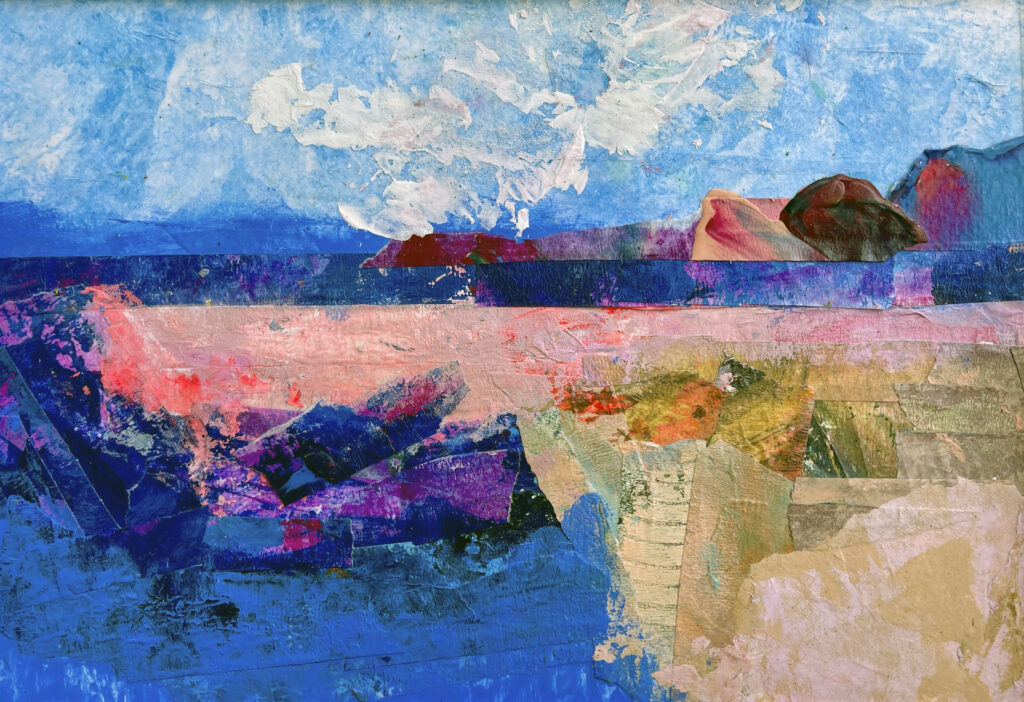
Troy began spending seasons in Santa Barbara, where the city’s thriving arts community gave her opportunities to exhibit her work and connect with fellow artists, continuing to shape her creative voice in ways her small mountain town could not. She explored acrylics, abstract painting, and collage before naturally blending the mediums into a style all her own.
“Whenever I finished, I always had paint left over, and the Midwesterner in me didn’t want to throw it out,” she says. “I’d scoop it off the palette paper and spread it onto other sheets. Before long, I had developed a bit of a paper habit and started collaging with those handmade papers. I mostly enjoy the mix of things.”
But those coastal retreats remained temporary until 2019, when a breast cancer diagnosis prompted Troy and her husband to rethink what they wanted the next chapter of their lives to look like.
“I think, when people trace their lives, they sort of have these things that make them shift from one place to another,” she reflected.
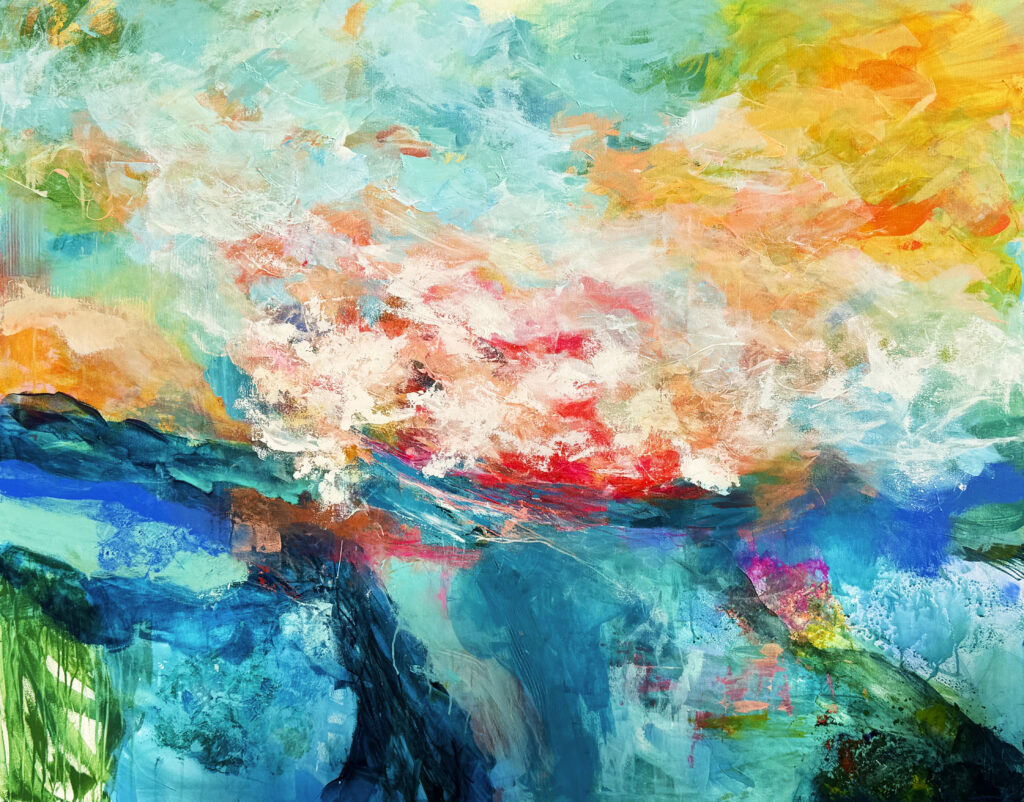
After several years cancer-free, they sold nearly everything they owned and headed for Florida. Before choosing where to settle, Troy spent nearly a year exploring Gulf Coast communities with a simple list of priorities: a thriving arts community, good libraries, and a home within 10 minutes of the beach. Their search ultimately ended in the Bradenton-Sarasota area, where Troy found the artistic community, and the coastal lifestyle, she’d been longing for.
Inspired by her deep love for the ocean, Troy aims to paint a feeling rather than a scene. She works with vibrant colors—never black, which she playfully says, “just seems like it’s shouting at me or something”—to capture the calm sense of arrival that comes while standing at the water’s edge.
“You know when you get to the beach and you have this big sigh of happiness? It’s like, ‘Ah! I’m at the place! I don’t have to think about being anywhere else.'”
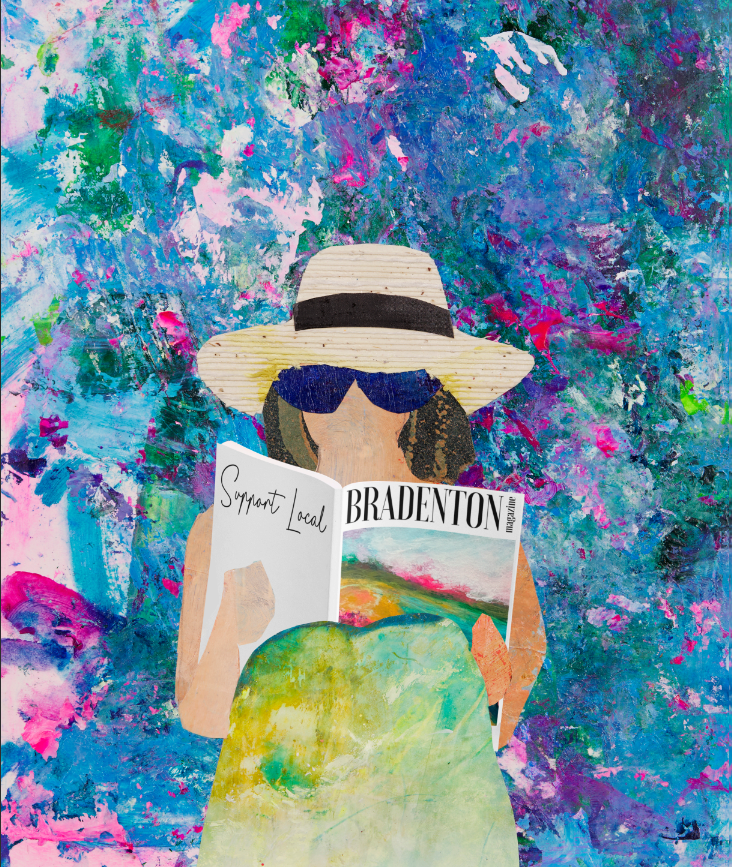
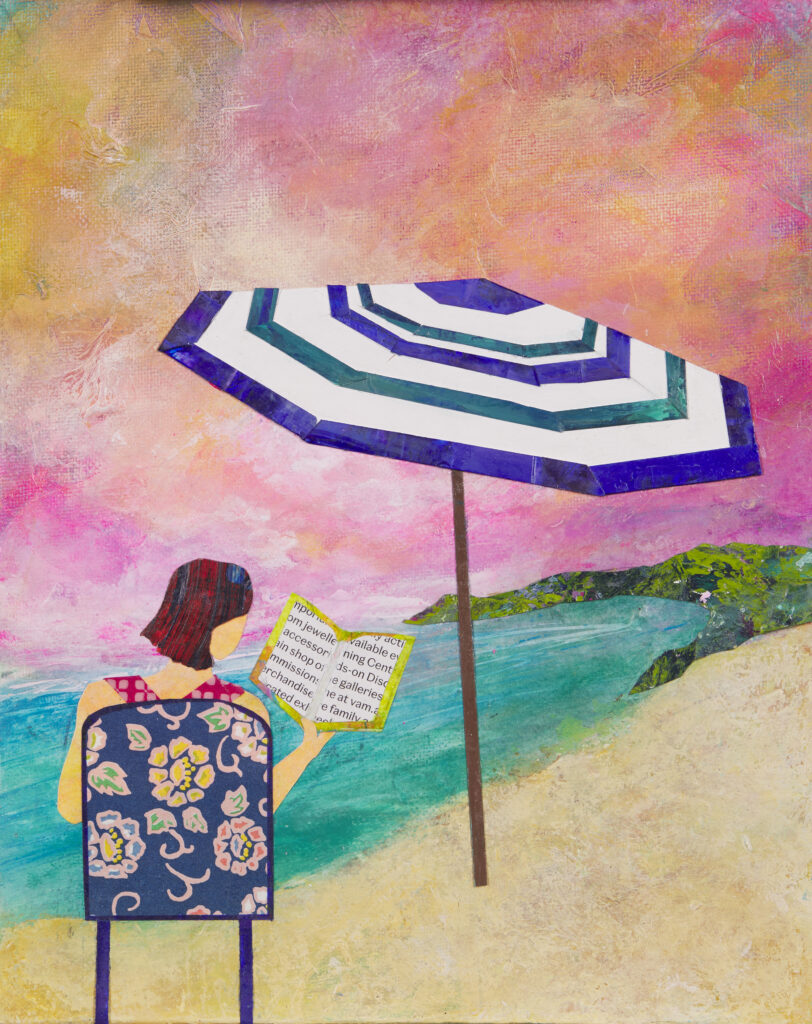
It’s the same feeling behind Troy’s Beach Readers series. Created during a 100-day art challenge, the collection brings together two lifelong passions—reading and the beach—with colorful portraits of women absorbed in books, celebrating not only the joy of the shoreline but the rituals and anticipation that come with bringing the perfect book along. One installment in the series graces the cover of this issue.
Today, Troy has become a fixture in the Bradenton-Sarasota arts community. An active member of both the Herrig Art Center and the Sarasota Art Center, she credits the Bradenton-Sarasota area’s welcoming network of galleries, guilds, classes, and fellow artists with inspiring this latest chapter of her creative life. Through her own work, she has become part of the creative landscape that first drew her to Florida.
Locally, Troy’s work can be found at the Herrig Art Center’s Live Artfully Artisan Boutique in Bradenton, the Artist Guild of Anna Maria Island, and The Cove in Bradenton Beach. To view more of her work, visit reentroy.art or follow @reentroyartist on Instagram. Her Beach Readers series can be found at @beachreadsart.